
These are Skyfall AI’s published showcase images, not outputs from our own model runs. A static rendering communicates an object’s appearance from one viewpoint. It cannot establish the hidden geometry, dimensions, constraints or operating behavior behind that appearance. The questions below are our suggested review criteria, not a list of verified SKY-001 capabilities.
Turbofan: a part hierarchy is not a working engine.
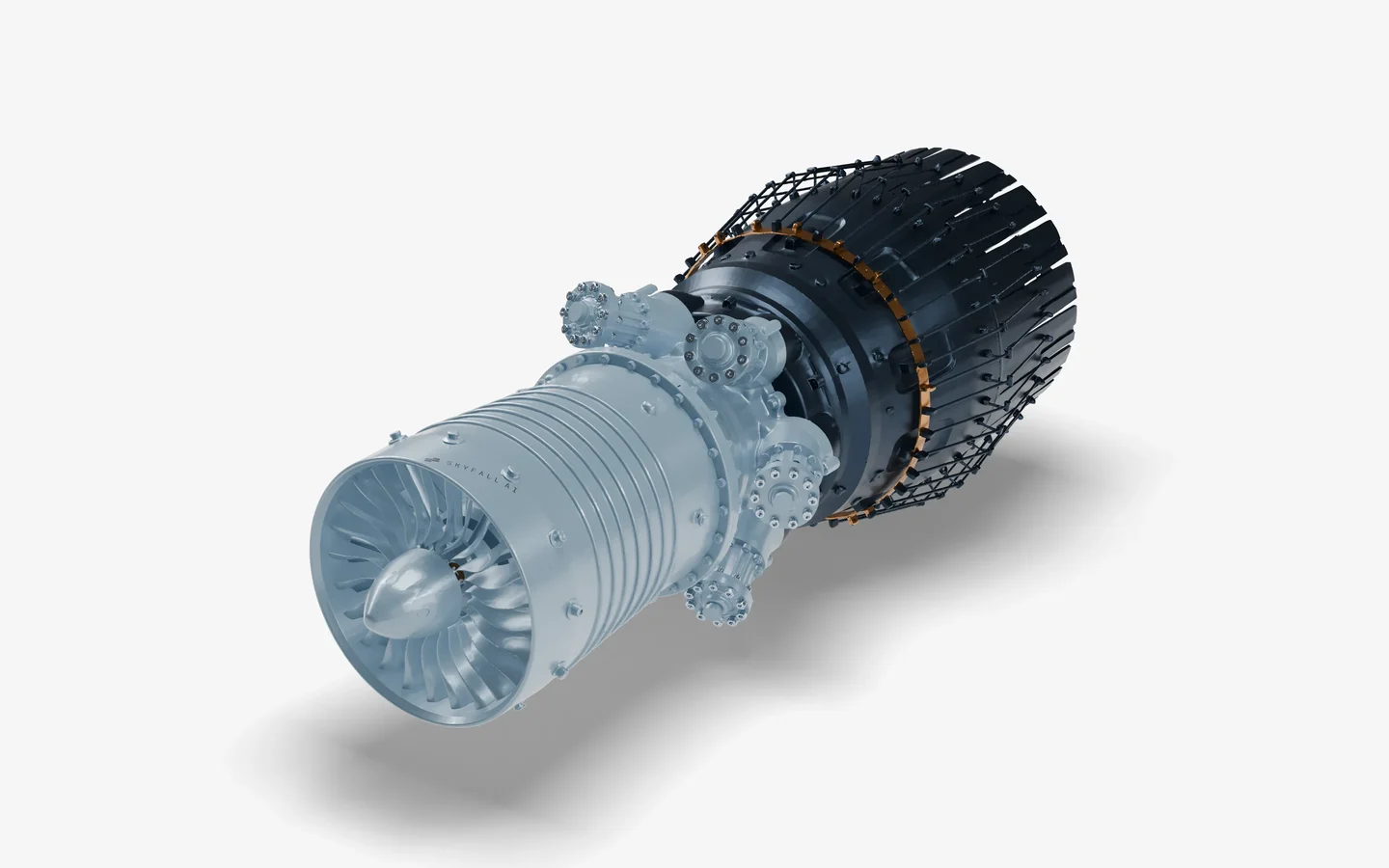
What the image is useful for
The engine is a useful prompt for thinking about nested assemblies: an overall object, component groups and individual parts. Skyfall’s research describes a Hierarchical Composer that splits a rough whole into a tree and refines its leaves. That makes hierarchy a relevant inspection target; the picture alone does not reveal whether every apparent component is represented as a separate, named part.
Our explanation of the Hierarchical Composer distinguishes generated internal geometry from measured geometry. Do not infer an accurate internal engine arrangement from a convincing external view.
Suggested inspection questions
- Part identity: if a design tree is available, which nodes describe the casing, rotating assemblies and their constituent parts? Are repeated elements distinct components or only surface detail? These are questions to ask, not claims about the supplied rendering.
- Interfaces: what locates one assembly relative to another? Request section views and measurable geometry to examine shared axes, mounting faces, intended clearances and unwanted intersections. A tree of parts does not itself establish mating constraints.
- Assembly coherence: do the part placements in the tree agree with those in each construction state? Can a reviewer distinguish an intentional gap from missing geometry without inventing a dimension?
Separate evidence is needed for flow and heat. A still image supplies no validated pressure, temperature, mass-flow or material data. Aerodynamic performance, thermal expansion and structural behavior need an engineering specification and appropriate analysis. Even a dimensionally consistent assembly would not establish those results, let alone an airworthy engine.
For a more manageable first review, use the two-part CAD acceptance exercise before extending the same evidence discipline to a complex assembly.
Sports car: exterior shape is not packaging evidence.
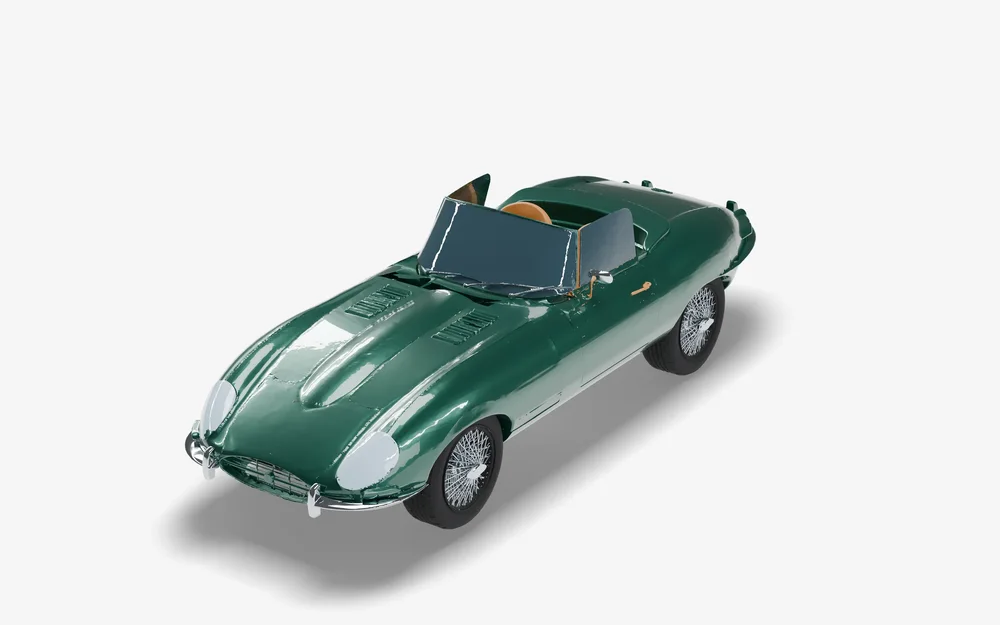
What the image is useful for
A car rendering lets a reader discuss the presented silhouette, proportions and arrangement of exterior forms. It does not supply a dimensioned surface model. An apparently smooth body is not evidence of mathematical surface continuity, panel thickness or a manufacturable panel definition.
Packaging asks a different question: can the required components occupy the available space and still move, cool, connect and be serviced? The exterior view cannot answer that question for the engine bay, passenger space, suspension or underbody. No hidden arrangement is verified by this guide.
Suggested inspection questions
- Surface definition: are inspectable surfaces or solids available, or only rendered states? Request units, reference dimensions and multiple views before assessing proportions. Review continuity and panel boundaries in the actual geometry rather than interpreting highlights as measurements.
- Packaging: which internal components and occupied volumes are explicitly represented? Request section views or a component inventory; label omitted volumes unknown rather than treating empty-looking regions as usable space.
- Mechanical constraints: if moving components are included, what defines steering travel, suspension travel and panel opening? Check their swept volumes against neighboring parts. A single attractive pose cannot demonstrate clearance through motion.
- Change propagation: if editing is offered, what happens to surrounding geometry when a wheel position or body dimension changes? Require before-and-after artifacts instead of assuming that a visual hierarchy preserves the relevant relationships.
These are proposed checks, not a claim that SKY-001 currently supplies a vehicle package, suspension model or editable surface history. The research places executable CAD operations and editable feature history on its roadmap. Our CAD handoff guide explains why a render, a geometry file and an editable model are different deliverables.
Welding robot: a pose is not calibrated motion.
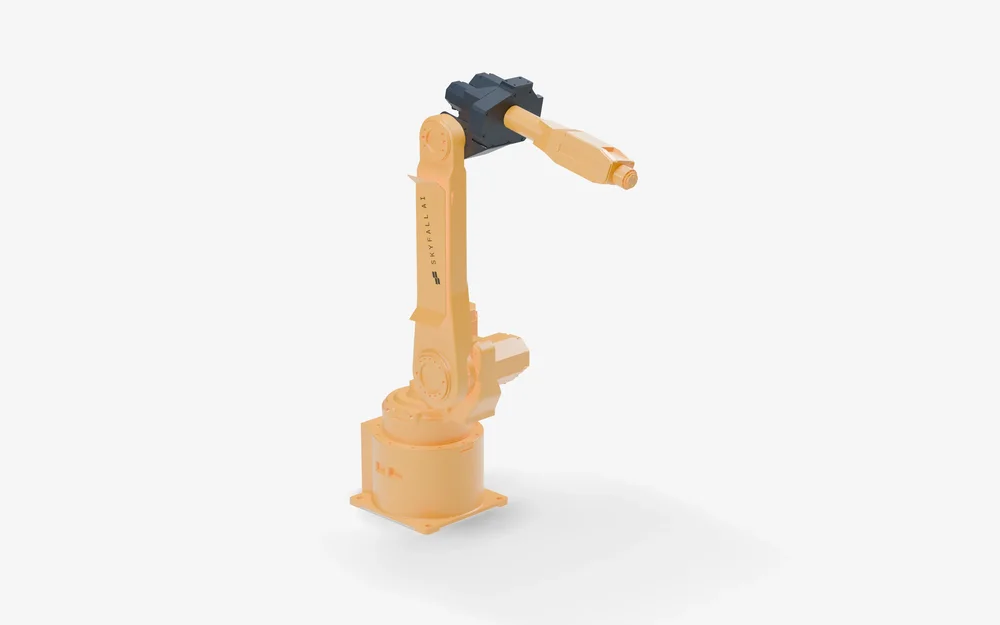
What the image is useful for
The robot example makes the distinction between component hierarchy and motion hierarchy especially important. A collection of arm-shaped parts can look like a robot without defining joint axes, limits or coordinate frames. The displayed pose does not establish reach throughout a workspace or the accuracy of a tool’s position.
A kinematic model relates joint coordinates to the tool’s position and orientation. Calibration checks that this model corresponds to a particular physical robot. Neither follows from a visual construction sequence, and neither is evidence of a working control system.
Suggested inspection questions
- Joint definitions: if a motion model is supplied, are joint types, axis directions, origins and permitted ranges explicit? Check how each link attaches to its parent rather than inferring joints from the rendered shape.
- Reach and orientation: what base frame and tool-center-point definition are used? Evaluate whether specified tool poses are reachable within joint limits, including the required orientation—not just whether the arm appears long enough.
- Path feasibility: can a proposed path avoid self-collision and nearby fixtures through its entire motion? A start and end pose are insufficient; intermediate configurations and problematic kinematic configurations need separate review.
- Calibration and control: what measured evidence connects the virtual geometry to a real robot, and what controller interface is actually supported? Keep positioning accuracy, timing, payload behavior and welding-process settings outside any claim based solely on this image.
No operational assurance is implied. This example is not a robot program, a validated welding path or a safety assessment. A physical cell requires qualified integration and safety review; a convincing model is not authorization to execute motion.
Before requesting a robotics trial, use the access guide’s integration questions to confirm available interfaces and artifacts. Do not assume that a showcased application establishes an integration or export format.
Turn visual interest into a bounded evidence request.
Start with one question you need answered: component identity for the engine, occupied space for the car, or joint definitions for the robot. Ask whether the available product can provide the relevant artifact before setting acceptance criteria. The images do not establish that those artifacts are available.
- Record provenance: distinguish the vendor’s showcase from a new evaluation run. For a run, retain the input, model version, supplied constraints and any manual intervention.
- Separate artifacts: inspect the part tree, sketches, intermediate states and any exported geometry on their own terms. Skyfall notes that animated transitions are illustrative and that saved sketches and 3D geometry can disagree.
- Keep unresolved questions visible: record which requirements are supported, contradicted or still unverified, with an artifact reference for each. Do not convert a missing dimension, component or motion definition into an assumed pass.
The benchmark methodology guide addresses a separate kind of evidence: vendor-reported construction-task results. Those results do not validate the thermal behavior of this engine, the mechanical package of this car or the control performance of this robot. For the model’s overall scope and roadmap, continue with how SKY-001 works.
Sources, image ownership and review scope.
- Skyfall AI: SKY-001 product page — source of the turbofan, sports-car and welding-robot showcase imagery and the product presentation.
- Skyfall Research: Introducing SKY-001 — October 19, 2026 article describing the Hierarchical Composer, visual construction states, demonstration caveats and future executable editing.
All three showcase images are credited to Skyfall AI; image rights and product names belong to their respective owners. Their inclusion is not evidence of endorsement by the depicted products’ manufacturers. This site is an independent, nonofficial guide and is not affiliated with Skyfall AI.
Our contribution is the inspection framework, not a reproduced experiment. We have not run SKY-001, inspected engineering files behind these images, validated the depicted assemblies or tested a physical system. The proposed questions identify evidence a reviewer would need; they do not assert that hidden features exist or that the model can supply them.